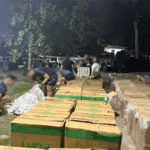
![A dump truck unloading garbage from a service-contractor at Tablon material recovery facility area in Cagayan de Oro City. [Photo courtesy of Clenro Cagayan de Oro]](https://www.themindanaotoday.com/wp-content/uploads/2024/02/National-1-4.jpg)
MindanaoToday.com | CdeO villages must solve garbage woes
By: Uriel Quilinguing
Garbage problem in Cagayan de Oro is primarily the responsibility of village officials, not of the city government, a former City Councilor said.
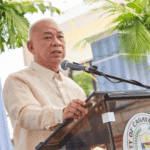
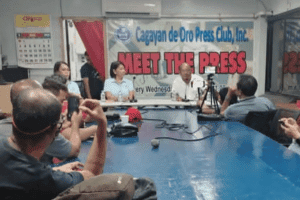
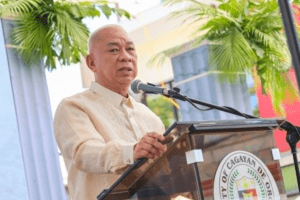
Eric Salcedo, designated overseer of the City Local Environment and Natural Resources Office (Clenro), emphasized this in a Meet the Press forum on Wednesday, February 6, at SM Downtown Premier mall in Cagayan de Oro.
He said the city government, through its garbage-collection service contractor, is supposed to collect only residual wastes (biodegradable) from the households while recyclable items (non-biodegradable) remain in the barangay.
Since last year, the city government entered into an agreement with Jomara Konstruckt Corporation and Tencil Construction joint-venture for garbage-collection services in assisting 80 barangay governments.
Salcedo, a village chief of Gusa prior to a City Council seat, said solid wastes must be segregated at source and the information campaign must be initiated by barangay governments.
Gusa was a recognized implementor of zero-waste scheme in early years of 2000, which includes waste-segregation at source, through the establishment of a Materials Recovery Facility (MRF).
An MRF includes a solid-waste transfer station or sorting/segregation area, a drop-off and storage center, composting structures, and units of recycling equipment.
But the Gusa MRF has long been neglected and attempts to sustain it failed, the former barangay chairperson said, and the same situation applies to other 37 other “unnumbered” or “rural” barangays, except for Pagatpat and Tablon.
“Only two have operational MRFs and these are in Tablon and Pagatpat,” Salcedo said and that among the 40 “numbered” or “urban” barangays, only the MRF in Barangay 22 is currently operating. Others deposit their recyclable solid-waste materials at the old dumpsite at Barangay Carmen.
He said many of these barangays would set-up “temporary” MRF for purposes of inspections during the search for “Oro Kalimpyo Awards” being initiated by Clenro with the support of the city government.
Salcedo said said Clenro has secured the green light from Mayor Rolando Uy to start issuing Ordinance Violation Receipts (OVR) under the city government’s Solid Waste Ordinance. Clenro is headed by Engineer Armen Cuenca as its department manager.
The Clenro overseer said they will start imposing the P500 first-violation penalty, as provided for under the Ordinance, pursuant to Republic Act No. 9003, the Ecological Solid Wastes Management Act of 2000.
Penalties under the Ordinance are lighter compared to the P1,000 fine and 15 days community service for convicted violators under Section 49 of R.A. 9003 and the prohibited acts are enumerated under Section 48.
These include littering, throwing, dumping of waste matters in public places such as roads, sidewalks, canals, parks, and establishments; open burning of solid waste; causing or permitting the collection of unsorted waste; open dumping or burying of wastes in flood-prone areas; unauthorized removal of recyclable materials, among others.
The Local Government Code of 1991, particularly Section 44, requires all provinces, cities, municipalities, and barangays through appropriate ordinances are mandated to address solid waste problems by establishing common waste disposal facilities.
Last year, Clenro reported that the city produces an average of 40,000 cubic meters of solid wastes every month, about 50-percent increase in five years. (MT)
###