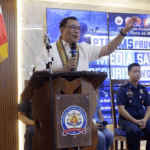
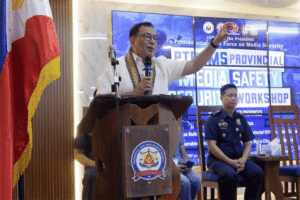
City Mayor Rolando A. Uy delivers his State of the City Address, June 15, 2026.
TheMonitorMindanaoToday.com | Blueprinting Cagayan de Oro City potentials over four decades ago
By: Uriel Quilinguing
CAGAYAN DE ORO CITY – “There are comparatively few urban areas that have the potential to become major economic centers which have sufficient attractions to be reasonable alternatives to Manila,” reads part of a World Bank’s Staff Appraisal Report Philippines on its Regional Cities Development Project (RCDP) on March 10, 1983.
This appraisal of a World Bank for its RCDP resurfaced three days ago—for those who keep their memories of the past–when Cagayan de Oro marked its 76th City Charter Day with City Mayor Rolando A. Uy’s delivery of the State of the City Address at the Golden Friendship Park.

Mayor Uy’s report, the 4th since his assumption as local chief executive, was focused on the performance of his administration in 2025 which the Department of Trade and Industry recognized as having “exceptional socio-economic performance” based on the agency’s Cities and Municipalities Competitive Index (CMCI) criteria.
Beyond this, the local chief executive who is now serving his second three-year term praised indomitable spirit of Cagayanons for realizing long-cherished aspirations for themselves and to the city.
Over four decades ago, Cagayan de Oro was one of the four sites for the World Bank fund-assisted RCDP was hatched in 1982, along with the cities of Davao, Bacolod, and Iloilo. The principal criterion for the selection was “considerable economic ‘take-off’ potential as key regional center.”
RCDP took off when the late City Mayor Aquilino Q. Pimentel Jr. (1980-1984) affixed his signature on the loan documents that would bind a portion of the local government revenues for 25 years. Then the late City Mayor Pablo P. Magtajas (1984-1998), then vice mayor, took over the administration of the RCDP.
CHALLENGES
The 30-year-old city had an estimated 228,000 population in 1980, posting among the country’s highest annual population growth rate of 6.7 percent for the 1975-1980, largely due to in-migration. Thus, roughly 33 percent of urban dwellers were in squatter and slum settlements without secure tenure, safe water, drainage, and human waste disposal.
Slum Improvement and Resettlement (SIR) was a key component of the RCDP though the newly-created National Housing Authority (NHA) and there were close to 7,000 household beneficiaries then, mostly in Barangays Macabalan, Puntod, and Kauswagan.
A master plan for city street network and drainage system was drawn and initially implemented in the población (then mainly Don Apolinar Velez and J.R. Borja main streets) as well as Barangays Nazareth, Carmen and other swampy areas. For the first time, traffic lights were installed.
Traffic flow and volume were calculated and measured, projected to get worse in the coming years, hence the establishments of bus terminals in Agora, Barangay Lapasan and at Bulua-Bayabas junction (now known as Westbound Bus Terminal).
Public markets in Cogon, Carmen and Puerto were rehabilitated as these were congested, unsanitary, and unsafe. The Slaughterhouse at Barangay Tablon was also constructed and equipped to handle 250 hogs and 35 large animals in a day in the 80s.
These were just among the key infrastructures that the World Bank Appraisal Mission recommended to be addressed. Composed of seven members, including a consultant, the WB team visited Cagayan de Oro in November 1981 and in April 1982.
The $21.8-million RCDP was intended “to accelerate the economic development by removing infrastructure bottlenecks.” World Bank loan component was $11.7 million while the Philippine counterpart was P10.1 million.
REUNION
Roughly three months ago (March 22, 2026), 16 former RCDP personnel who spent seven productive years of their lives had a half-day reunion of sorts at an exclusive room at Sentro 1890 Restaurant. All in their senior years, yet they were still sharp in recalling what was it like from 1982 to 1987 when they were reporting for work at the RCDP City Project Office at Barangay Nazareth and later at President Roxas-Yacapin Streets (Cogon area).
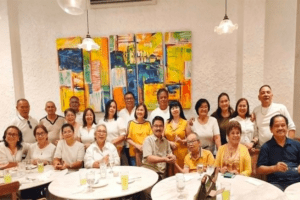
RCDP CPO Engineering Unit Head Engr. George Brońola and Administrative Unit Head Medardo Calo attended the reunion that started with sumptuous lunch, courtesy of Leandro C. Quilinging who for years been working in the Senate, a former RCDP draftsman. They were joined in by Gilda S. Abellera and Fe P. Ancheta who are both engineers, and staff personnel Ethelinda Dy-Edrote (who had a stint as city planning and development officer), Andrew Abas, Ben Balagot, Nelia T. Castrodes, Celina Pimentel-Dalagan, Virginia S. Deguinio, Venus Alvi-Luzon, Marilyn Rago-Mabellin, Pacita B. Obsioma, Antonio Pontipedra, and Evelyn A. Velasco.
Among those they missed were RCDP CPO Manager Antonio Rodriguez Jr. (+), a former city administrator; Engr. Antonio Janubas (+), the city’s first head of the Office of the Building Official; and Engr. Ramon Ortiz (+) who was then the Shelter Sector Manager. Lawyer Christina Malferrari Jugador who was also Shelter Sector head had a prior commitment.
Those they recalled as RCDP foreign consultants were Engr. James Patrick Arthur, Engr. Trevor Briggs, Aage Chris Christensen, and Per Wellendorph who came to the city, one after the other.
Towards the end on the gathering, the RCDPians organization was formed. They know that the blueprint for what Cagayan de Oro would become, at least within their lifetime, have already been drawn. Realizing them remains work in progress. – The author was one of the technical personnel of the Plan (Macro) Formulation Division, National Economic and Development Authority (NEDA) Regional Office 10 when Cagayan de Oro was selected as one of the four cities outside Metro Manila for an urban planning initiative (1982-1988) through World Bank’s Regional Cities Development Project (RCDP).
###