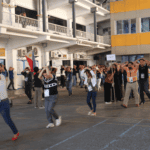
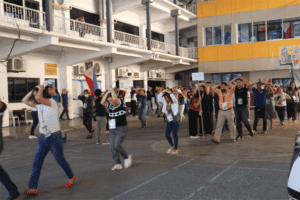
Tumpagon dance troupe, the champion
MindanaoToday.com | Showcasing the authenticity of Higaonon cultural arts
By: Uriel Quilinguing
CAGAYAN DE ORO CITY – Over a hundred years ago, when migrants from Visayas and Luzon came here, then known as Cagayan de Misamis, there was already a community of settlers known as Higaonons. Some stayed and embraced new practices, including belief in the higher being they refer to as Magbabaya, others got baptized to Christianity.
Higaonon cultural practices and traditions, however, have been preserved all these years, something the Catholic Bishops’ Conference of the Philippines (CBCP) recognize and respect. The CBCP has its Episcopal Commission on Inter-Religious Dialogue (ECIRD) and has been cultivating its Indigenous Peoples Apostolate (IPA) all over the country, including within the Archdiocese of Cagayan de Oro (ACDO).
Jesuit priest Antonio Ledesma, now archbishop emeritus of ACDO after his retirement four years ago, had served as chairperson of CBCP’s ECIRD for over a decade, guided by his episcopal motto: Peace is the Fruit of Solidarity (Opus Solidaritatis Pax) which he lives up until today, pursuing his lifelong mission through the IPA of ACDO.
With Higaonon groups in over a dozen upland villages in the southwestern fringes of Cagayan de Oro, the octogenarian religious leader has been presiding over dialogues since last year with tribal leaders. IPA has been advocating for the rights of the IPs, promoting ancestral lands, supporting self-determination, and respecting the dignity of every culture.
Roman Catholic clergy, Father Renerio “Jojo” Sabuga, a Higaonon by ancestry, and director of ACDO’s IPA, has been with Ledesma in these engagements with the Higaonons. And one of the tangible results was to stage the 1st IP Cultural Dance Competition on October 30, 2024 to highlight the IP Month celebration culmination. They got the support of the city government for this.
TOP PERFORMERS
True enough, seven groups of performers joined, each composed of no less than 20 dancers, instrumentalists, and production crew, most of them in youthful age. They were on stage for the first time of their lives at the Lourdes College auditorium in an educational institution that has long been part of city’s history.
Raul Ilogon, chairperson of the Board of Judges, said the performers from Tumpagon had a total package of traditional costume, dance steps, sounds, rhythm, and props that are authentic Higaonon, hence they got the highest scores and won P50 thousand and trophy.
He said Tumpagon had a mixture of dance moves that included the popular dugso (ritual dance) and interpretations of how Higaonons do farming from planting to harvesting, as well as courtship.
Gimbal, tambol, agong, and indigenous percussion instruments (tulali and subing), made out of bamboos, produced unique sounds that matched hand-movements, footsteps, and the swaying of bodies. The females had their panica (headdress) and bali-og (necklace) while the males with tangkulo (headdress) with kulong-kulong.
Jheremiah Daug, who is in his early 20s, a dancer from Mambuaya, said they did their best in staging their repertoire of dances, but admitted they relied solely on sounds and beats that were recorded on a cellular phone.
He said that even if they settled for the second spot, he is personally satisfied representing their village, knowing the P20 thousand pot money prize may not be enough to pay for the services of a trainer and rentals of costumes and props.
Barangay Bayanga took the third place with trophy and P10 thousand prizes. Other performers were from the villages of Lumbia, Tagpangi, Tignapoloan, and Tuburan and every dance troupe got P2 thousand and certificate.
Other than the chairperson, other judges were Josephine Bacal, a retired judicial court judge; Adrian Nagac, Carl Cesar Rebuta, Nanette Roa, Tessie Sambaan, and Levenia Angcod-Suazo—all with proven integrity and deep knowledge of the cultural traditions of the Higaonons.
BEHIND THE SCENE
Roberto Ansaldo, chairperson of the Apu Palamguwan Cultural Educational Center (APCEC), shared in his opening remarks, how collaborating with the IPs has worked wonders in providing potable water in an outskirt community in Malaybalay City. He had served also as undersecretary of the agriculture agency.
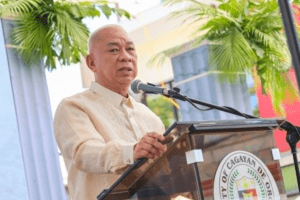
Lawyer Roy Hilario Raagas, the city administrator, represented Mayor Rolando Uy, in the activity who was introduced by the Mayor’s chief-of-staff Shiela Lumbatan.
Lillie Marlene Sheng de la Serna, a consultant of the City Mayor’s Office, did the coordination tasks. As the program coordinator, invitations were sent to all 12 rural barangays in the first congressional district, knowing these villages have sizeable number of residents with Higaonon roots.
IP mandatory representative in the City Council, Roberto Cararing, also known as Datu Makilala, was in the event but did not stay long.
Of the 40 semi-urban, semi-rural, and rural villages in Cagayan de Oro, 16 have residents who can still be classified as Higaonon natives, though they no longer wear traditional costumes, except in stage presentations and parades. They roughly represent 28 percent of the over 820 thousand city residents.
October 24, 1997 was the historic day when the Indigenous Peoples Rights Act (IPRA) was signed into law, hence the annual IP Month declaration. This helps preserve Higaonon cultural traditions for the next century, long after organizers of the 1st IP Cultural Dance Competition are gone. [ Uriel Quilinguin/MT]
###