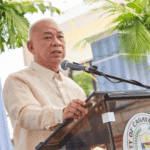
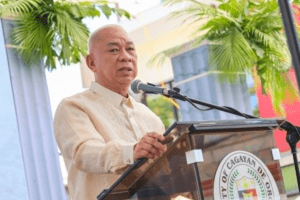
Jose Apollo Pacamalan, regional executive director of the Department of Agriculture in Northern Mindanao. PIA-10 photo
TheMonitorMindandanaoToday.com | Rice import ban benefit farmers
By: Uriel Quilinguing
CAGAYAN DE ORO CITY – With farm-gate prices ranging from P17 to P23 per kilo since September 1 when the moratorium on rice importation took effect, palay farmers in Northern Mindanao are assured of profit margins despite the high cost of production inputs.
Jose Apollo Pacamalaan, regional executive director of the Department of Agriculture Region 10, made this assessment in a Media Connect forum on Wednesday, December 17, at Harbor Lights Resort, when asked on the effect of the temporary ban on rice imports.
Initially intended for 60 days starting September 1, when President Ferdinand Marcos Jr. issued Executive Order No. 93, the suspension on rice importation was later extended until December 31, this year, under Executive Order No. 102.
The issuance of E.O. 93 was prompted by the agriculture agency’s projected palay production of 20.46 million metric tons (MMT) this year, though this was trimmed in September to 20.39 MMT due to typhoons – higher than 2023’s palay harvest of 20.06 MMT.
The temporary ban on rice imports was intended to help Filipino farmers sell their palay at fair and reasonable prices, to enable domestic market to absorb locally produced rice, and to stabilize rice prices.
These, Pacamalan said, are evident in Northern Mindanao recalling that there were instances when farm-gate prices of palay were between P12 to P15 per kilo and farmers would rather keep their produce than sell. Now, they’re getting P17 to as high as P23 per kilo for palay of 14-percent moisture content.
He admitted though that the rice sufficiency level of Northern Mindanao is only 83 percent, hence there is the remaining 17 percent which imported rice supply could fill, but DA-10 has been promoting carbohydrate substitutes that includes corn, root crops – and even bread, noodles, and pasta. “Lean months will start in January, then the country needs to import rice,” he added.
Without imported rice, the region has 31 days buffer stock of rice compared to 89 days buffer stock when imported rice supply competes against bountiful harvests in Northern Mindanao, particularly those vast irrigated lands devoted to play production in Valencia City.
LOCAL VS IMPORTED
In its price index of selected crops on December 17 this year, the DA-10 posted online that the average price of well-milled local rice was P45.47 while regular milled rice was P40.56 while imported well-milled rice was P43.10.
“While imported well-milled was cheaper, it’s appearance appealing because grains are full and polished, yet when you cook it there is an after smell,” Pacamalan said, hinting the imported rice may have been stored for long – likely procured before the import ban took effect.
In DA-10’s price index on September 30, data showed that the average price of well-milled local rice was higher at P44.48 kilo compared to imported well-milled rice of P40.21 a kilo, thus the pricing competition, clearly edging local palay farmers from domestic market.
The agriculture agency knows why Filipino farmers, particularly those in Northern Mindanao, cannot compete with countries where imported rice come from such as Vietnam, China, and even India.
IMPORTATION WOES
These include import dependence on agriculture inputs, high post-harvest losses, low mechanization, irrigation bottlenecks, and even extreme weather conditions due to climate change, as presented earlier by DA-10 Regional Technical Director Lana May Racines.
“We are importing about 80-percent of our palay seeds,” Pacamalan said and that this is one of the agricultural inputs that eats up 19.5 billion US dollars of the DA’s 2024 budget. Due to low mechanization, post-harvest losses account for 14 percent of the produce and that only 65 percent of farms have stable source of irrigation water.
The DA-10 head said they are confronting the challenges head on, but it will take some time before they could fully address them, hoping they could increase the Agriculture, Forestry and Fisheries sector’s growth in 2024 which was almost negligible at 0.1% growth, according the Philippine Statistics Authority’s estimate. The AFF sector grew by 3.8% in 2021—a COVID pandemic year — but dropped to 0.5% in 2022, and 0.3% in 2023.
Although the AFF sector’s share in the 2024 Gross Regional Domestic Product (GRDP) was only 17.9 percent, overshadowed by Services and Industry sectors, Bukidnon still ranks first nationwide among provinces with largest economies in gross value added (GVA).
The landlocked province contributed P129 billion or 7.3% of the nation’s 2024 GVA of P1.78 trillion, followed by Nueva Ecija 4.5% (P82 billion), Pangasinan 3.9% (P68 billion), Pampanga 3.7% (P65 billion), and Isabela 3.3% (P59 billion.
In terms of production, Bukidnon ranks first in pineapple and cattle, second in banana, cassava, corn, and tomatoes, and third in poultry products.
Sixty-nine percent of the P187.06 billion GVA of AFF in Northern Mindanao, which is valued at P129.03 billion, came from Bukidnon, according to the PSA.
Pacamalan, who had a long stint in cooperatives, assumed the DA-10 leadership 16 months ago. (Uriel Quilinguing)
###