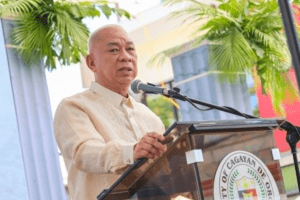
Office of Civil Defense-10 Regional Director Antonio Sugarol (2nd from right) leads the discussion in a Kapihan sa PIA forum for the 2025 National Disaster Resiliency Month, July 8, 2025 at Limketkai Center, Cagayan de Oro City. PIA-10 photo
TheMonitorMindanaoToday.com | Resiliency from flooding still a daunting challenge
By: Uriel Quilinguing
CAGAYAN DE ORO CITY, Philippines – Urban flooding due to moderate at times heavy rains no longer surprises residents here as they already had the worst in 2011; their ability to respond to hazards and recover from the effects of disaster has been recognized, thus this city has been among the country’s most resilient.
Antonio Sugarol, director of the Office of Civil Defense in Northern Mindanao (OCD-10) and chairperson of the Regional Disaster Risk Reduction and Management Council (RDRRMC), highlighted this in the Kapihan sa PIA forum on Tuesday, July 8, last week when he said: “There is no end-point in resiliency.”
He said that due to climate change responding to flooding –- and other natural and human-induced hazards — will be a continuing activity of the RDRRMC member agencies and local disaster risk-reduction bodies, not only during the National Disaster Resilience Month observance in July but all throughout the year.
“There is no beginning and end, hence the OCD continues to assess how local governments are responding to these (hazards), long term,” he said, and on how the mandated 5% allocation from their National Tax Allotment (NTA which was formerly known as Internal Revenue Allotment) is being utilized.
Sugarol said for the city government of Cagayan de Oro, 5% of its NTA would be in several millions and that 30% of that is intended for emergency response and 70% for disaster prevention and mitigation, preparedness, rehabilitation, and recovery.
Starting today, July 14, the RDRRMC is conducting a capacity-building activity for responders dubbed as “RDRRMC Rescue Olympics 2025” and this will be at the Cagayan de Oro River Boulevard — a floodwall structure component of the P8.5-billion Japanese International Cooperation Agency (JICA)-assisted Flood Risk Mitigation Project (FRIMP) to prevent a repeat of the 2011 Typhoon Sendong tragedy.
Within the year, the Department of Interior and Local Government in Northern Mindanao will also be gathering representatives of local governments, particularly those involved in the issuance of building and occupancy permits, in a training on assessing structural integrity of buildings, according to DILG-10’s Hazel Occeńa, local government capability development chief. She is coordinating with the Department of Public Works and Highways-10 (DPWH-10) for this.
In the same forum, Engineer Leowald Pecore, who heads the planning office of DPWH-10, said they often encounter insufficiency of quick-response fund for repairs and rehabilitation of damaged road, bridge, and flood-control structures due to natural hazards such as heavy rains that trigger flooding, landslides, scouring, breaching, and debris accumulation.
He said that during the COVID-19 pandemic (2020-2022) there were no fund releases for maintenance of roads and bridges and flood-control structures, and they did not receive additional funds on their 2023 and 2024 annual budgets.
But they were surprised there were fund released to them out of “congressional insertions” which, he said, may also be part of their “unprogrammed budgetary allocation” that was the subject of congressional inquiry in last year’s budget hearing,
Pecore said that while the DPWH-10, with their district engineering offices, conducts annual assessment of road, bridge, slope protection, flood-control, and public buildings, the results of which were supposed to be the basis for funding, yet there were projects not in their “menu” that were identified and funded.
Pecore said while their mandate has been focused on national roads and bridges and flood-control structures — worth P100 million and above — on major rivers, DPWH-10 has been working closely with their two district engineering offices in this city since 2017 when a master plan and feasibility study were conducted to address urban flooding.
One of the findings, he said, was that flooding and heavy traffic that the city has been experiencing for almost two decades now are results of “poor urban planning” and that these must be addressed through structural and non-structural interventions.
He said they have yet to reach 50 percent in the implementation of drainage and flood control projects that started in 2022, dismissing netizens’ comments that DPWH-10 failed in addressing urban flooding in the city, that many of these are left with no workers on site for months. There were other drainage projects through that began in 2019.
Pecore said they are dependent on fund releases and, if the funds are available, they have yet to negotiate with landowners for the right-of-way of drainage projects and informal settlers, the very reason that there are road projects that are fragmented (pat-ak-pat-ak).
Earlier, the DPWH-10 disclosed in a state-broadcast program that the entire drainage project in Cagayan de Oro has a total budgetary requirement of P7.6 billion and that the initial release was P3.20 billion.
These drainage projects primarily involved four catchment areas or creeks: Bitan-ag, Carmen, Kolambog and Sapang. The master plan and feasibility study, however, included Bantiles Creek in Bugo, Puerto Creek, and the rivers of Agusan, Biga-an, Bungcalan, Cugman, Iponan, and Umalag. (Uriel Quilinguing/MT)
###