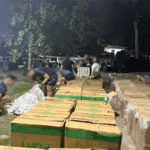
Counterfeit P500 and P200 banknotes that personnel from Cogon Police Station, Cagayan de Oro seized on Saturday, April 5, 2025. [Photos by Jonathan Bullo]
MindanaoToday.com | Police warn public of fake money in Cagayan de Oro
By: Uriel Quilinguing
CAGAYAN DE ORO CITY, Philippines – The police office here has advised the public on Wednesday, April 9, to report once counterfeit paper money is detected upon payment of goods.
Lieutenant Colonel Evan Vińas, spokesperson of the Cagayan de Oro City Police Office (Cocpo), said they are monitoring the circulation of fake banknotes, victimizing public market vendors, gasoline stations, and convenience stores.
On Monday, April 7, Cogon Police Station got two 500-peso and 200-peso marked papers that were turned over after knowing these were bogus paper money.
The two P500 fake paper money were paid to a gasoline station, found to be counterfeits only after the customer has left, while the fake P200 bill was from a fruit vendor who got it with a genuine P50 bill from a customer who bought two kilos of mango—each kilo at P125. These occurred on April 4 and 2, respectively.

In 2021, the Bangko Sentral ng Pilipinas (BSP) came up with a three-step inspection method called feel-look-and-tilt that may use to determine real from bogus banknotes.
One could feel the authenticity of the banknote because a security paper, made of abaca fiber, is used which has textures compared to the common paper. It has embossed prints across its surface.
In terms of look, there is an “apparition” of images (persons, animals or plants) on the paper which the BSP calls as “watermark” which shows shadows of objects seen under the light.
There are also security fibers that are visibly spread, in red and blue colors, on the front and back of the banknote.
An asymmetric serial number is also found on the paper bill, with two prefix letters and six to seven digits, the font of which increases in size and thickness.
At the lower corner is a see-through mark; one could notice a truncated Babaylan script if one holds the paper money against the light. The script means “Pilipino.”
One may also tilt the banknote, at a 45-degree angle and the money’s value could be seen over the portrait. There is a blue-naped parrot on a 500-peso bill, the 1,000-peso bill has a clam with the South Sea pearl.
One may even try to scratch the bill and if the printing smears or shows any sign of damage, then the paper money is a counterfeit. [Uriel Quilinguing/MT]
###