Photo by Jun Marron
TheMonitorMindanaoToday.com | PHINMA COC boosts blood donation drive
By: Uriel Quilinguing
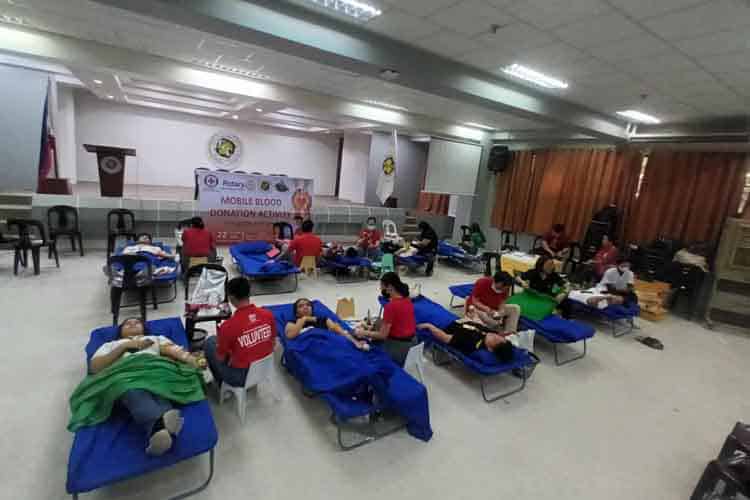
CAGAYAN DE ORO CITY, Philippines – One hundred thirty-eight criminology students of PHINMA Cagayan de Oro College responded on Saturday, November 21, to the call of the Philippine Red Cross Mindanao Regional Blood Bank (PRC-MRBB) for donations in anticipation of blood supply scarcity during holidays.
Only 111 of them, however, had successful extraction of blood, either in the amount of 350 cubic centimeter (cc) or 450 cc, depending on donor’s weight and blood pressure which were part of the physical and health assessments.
Every bag of blood, consisting of red cells, platelets, and/or plasma, could save three human lives, particularly those undergoing surgery, dialysis, giving birth, bleeding disorder such as dengue, cancer like leukemia, and victims of accidents, and armed conflicts.
Gerry J. Cańo, dean of PHINMA COC’s School of Criminology and Criminal Justice, underscored the assistance of the Rotary Club of Cagayan de Oro in facilitating with the PRC-MRBB the blood-letting activity and support of the faculty members and student organizations in disseminating the information.
“Thank you to all (donors) who took the courage and willingness to donate blood,” Cańo said, adding that blood donation has been a regular annual activity, participated in by students in Bachelor of Science in Criminology. The blood-letting was held the PHINMA COC gymnasium, along Mayor Max Suniel Street in Barangay Carmen.
As tabulated by Medical Technologist Aries Chris Oraiz of PRC-MRBB, the 111 bags of collected blood consisted of 53 for Type 0, 25 for Type B, 24 for Type A, and nine for Type AB. Type O blood is the most common, representing about 46 percent of Filipinos.
As observed in its Mobile Blood Donation campaigns, the PRC Misamis Oriental which oversees the operation of the MRBB here, particularly in higher educational institutions, donors must be in good health, 16 to 25 years old, and must weigh at least 110 pounds.
Also, donors must have a blood pressure of 90-160 mIu/Hg (systolic) and 60-100 mIu/Hg (diastolic) – mLu/Hg is the abbreviation for milli-International unit per milliliter, the unit of measurement of blood pressure.
Relatively high blood pressure occurs when one does not have enough sleep and rest, has taken alcohol in the last 24 hours, must have taken medication in the past 24 hours, but one must have taken a meal – not fatty or oily – prior to blood donation. (Uriel Quilinguing)
###