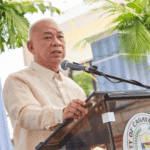
Secretary Renato Solidum planting a bamboo seedling at Pagatpat, Cagayan de Oro City on October 18, 2024. Photo by DOST 10
MindanaoToday.com | DOST bullish on bamboo fiber as materiel for AFP
By: Uriel Quilinguing
CAGAYAN DE ORO CITY – The state’s science and technology agency is optimistic of the country’s bamboo industry, particularly on textiles from bamboo fibers, once the law on Self-Reliant Defense Posture (SRDP) is fully implemented.
President Ferdinand Marcos Jr. signed Republic Act No. 12024 or the SRDP Revitalization Act on October 8, 2024, a gesture which officials of the Armed Forces of the Philippines hailed.
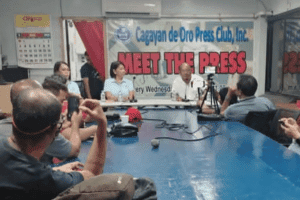
In a press conference here on Thursday, October 17, to drumbeat an attempt to set a Guinness World Record for the “Most People Planting Bamboo Simultaneously,” officials of the Department of Science and Technology (DOST) said they hailed the SRDP law.
With the SRDP law, military uniforms may be made from textiles out of bamboo fibers that are produced in the country, according to Jenneli E. Caya, supervising science research specialist of the Philippine Textile Research Institute (PTRI).
Caya said the PTRI has the technology and equipment to produce bamboo textiles, knowing that bamboos grow abundantly across the country, much more in Mindanao. By then, she said, the country need not import textiles also from bamboo fibers.
Aside from the current estimate of 150,000 personnel of the Armed Forces of the Philippines (AFP), there are also almost 230,000 organic members of the Philippine National Police that are issued uniforms every year. There are over two million government workers who also need sets of uniforms, according to the Civil Service Commission.
Rico Cabangon, the acting director of the Forest Production Research Institute (FPRI) who was also at the press conference here, said they are not only looking at bamboo textiles as materiel for the AFP but also for the production of military grade bullet-proof vests. FPRI has conducted tests on vests out of bamboo fiber and were proven to be impenetrable by bullets from low-powered firearms.
He said bamboo planters need not wait for three to five years so they could earn or recover from their investments, both on labor and capital, because paper out of bamboo fibers comes from relatively young bamboos. The ideal strength of the bamboo fiber would depend on the species of the bamboo and there are at least eight known species in the Philippines, aside from the giant bamboo that has gained popularity in recent years.
SOURCE OF INCOME
Engineer Romela N. Ratilla, regional director of DOST 10, said they are willing to assist those who wish engage into bamboo plantation venture; in the conduct of feasibility studies, training in the use of technology, procurement of equipment, and access to financial assistance.
Ratilla said there is a need to establish closer collaboration among agencies, linkages with the private sector, and market information exchange among bamboo industry stakeholders. Often, manufacturers and processors of bamboos said they lack or have no raw materials, yet bamboo growers also complain they have no buyers.
Current industry data highlights bamboo as a promising source of income for our farmers. In one hectare of bamboo plantation, approximately 300 clumps can be cultivated. Each clump, aged three to five years, can yield around 10 bamboo poles annually, translating to a potential gross income of up to P897,000 per hectare.
The DOST intends to raise awareness on bamboo and in promoting sustainability, circular economies, and climate resilience—showcasing bamboo’s potential as a renewable resource which is vital to the industry’s value chains.
BAMBOO PLANTING
On Friday morning, October 18, planters in 19 different locations in the country conducted a simultaneous bamboo planting to set a record for most people planting bamboo simultaneously.
Secretary Renato U. Solidum Jr. and Undersecretary for Regional Operations Engr. Sancho A. Mabborang of the DOST joined the bamboo planting activity at Pagatpat village, Cagayan de Oro. They were joined in by 2nd District Representative Rufus Rodriguez and Vice Mayor Jocelyn Rodriguez.
Solidum, Mabborang, Cabangon, and Ratilla were among the 1,042 DOST personnel who personally planted bamboo seedlings that day in various sites.
In Bukidnon, the planting locations were at Santa Fe, Libona; Kalasungay and Northern Mindanao Agricultural Crops and Livestock Reseach Complex (NMACLRC) in Malaybalay City; Sta. Ines in Malitbog; Alae, Dalirig, and Maluko in Manolo Fortich; Puntian in Sumilao; and at San Isidro in Talakag.
Bamboo planters were also at Lanise in Claveria; Mandangoa in Balingasag; Awang in Opol; and Sta. Ana in Tagoloan, all in Misamis Oriental, and at Pagatpat in Cagayan de Oro.
The same activity was also held at Gupitan and Kapalong towns in Davao del Norte; Kapoc and Matanao in Davao del Sur; Poblacion, Carmen in North Cotabato; Simbalan in Buenavista, Agusan del Norte; and at Calbugos in Villaba, Leyte.
Over 80 institutions from Mindanao have collaborated to gather 3,990 planters who aim to plant at least 20,000 bamboos. The bamboo seedlings they planted were geotagged for visits of a team from the Guinness World Records and for subsequent monitoring and inventory.
The final count and result will be announced on November 28 this year during the Circular Economy Forum at the National Science, Technology, and Innovation Week (NSTW) in this city. (Uriel Quilinguing/MT)
###