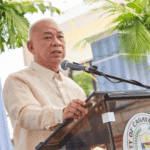
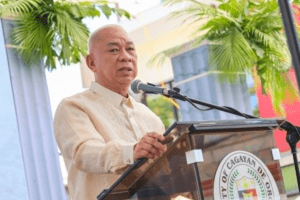
Engineer Eugene C. Raposala III of the Department of Information and Communications Technology Region 10, with forum host Jan Albert Arańa of the Philippine Information Agency 10, February 20, 2025. (PIA-10 photo)
MindanaoToday.com | DICT-10 dispels doubts on connectivity issues
By: Uriel Quilinguing
CAGAYAN DE ORO CITY, Philippines – Residents of geographically isolated and disadvantaged areas (GIDA) of Northern Mindanao region need not go somewhere else so they could receive and transmit data and messages through electronic gadgets as they are already connected to the digital world.
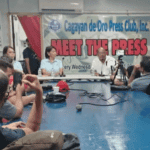
Engineer Eugene C. Raposala III, technical operations head of the Department of Information and Communications Technology-10, made the assurance on Thursday, February 20, in a Kapihan sa PIA forum at Limketkai Mall here, to brush aside uncertainties in the smooth electronic transmission of results in the May 12 elections this year.
Raposala said that DICT-10 has already resolved connectivity issues of 54 barangays in Northern Mindanao’s outlying areas after establishing 696 wireless access points (WAP) in 542 active locations, as of the end of December 2024. They have 916 sites across the region’s five provinces and nine cities.
He said the equipment that the DICT-10 installed are solar-powered so these continue to function if electricity from the grid—from varied fossil, hydro, and fuel-based power sources—trips off.
The very small aperture terminal (VSAT) technology, a satellite communication technology that allows data to be transferred between stations, uses solar energy. DICT-10 personnel could install VSAT anywhere, including so-called “dead spots,” so transmission of messages and images would be uninterrupted.
Moreover, he clarified that their participation in the forthcoming electoral exercise would depend on the guidelines from the Commission on Elections (Comelec) and that, most likely, would be in electronic hubs that would set-up in every province in case the automated counting machines (ACM) malfunction.
This, he said, would be DICT’s supportive or coordinative role to the Department of Science and Technology (DOST) as the latter has been tapped by Comelec, under a memorandum of agreement, in previous elections.
Earlier, the Comelec announced the ACM units that will be used in the May 12 midterm elections are all brand-new and of South Korean technology. Some 4,464 ACMs are to be utilized in Northern Mindanao corresponding to the number of clustered precincts in 1,908 voting centers regionwide. Region 10 has 3,190,362 registered voters.
In Camiguin, for instance, the DICT-10 has rolled out its “Free WiFi for All” program in the entire island province to boost its preparedness and resiliency against natural hazards, thus all its local (municipal) disaster risk-reduction and management offices (LDRRMO) are linked to the provincial disaster risk reduction and management office (PDRRMO).
The island province has 51 Wi-Fi (wireless fidelity) zones that includes public schools, hospitals, municipal buildings, and three barangay halls—out of 57 villages.
Raposala said their ultimate goal is to ensure the connectivity of 2,022 barangays in the region through the government’s “Free WiFi for All” program which is under the DICT’s mandate. [Uriel Quilinguing/MT]
###