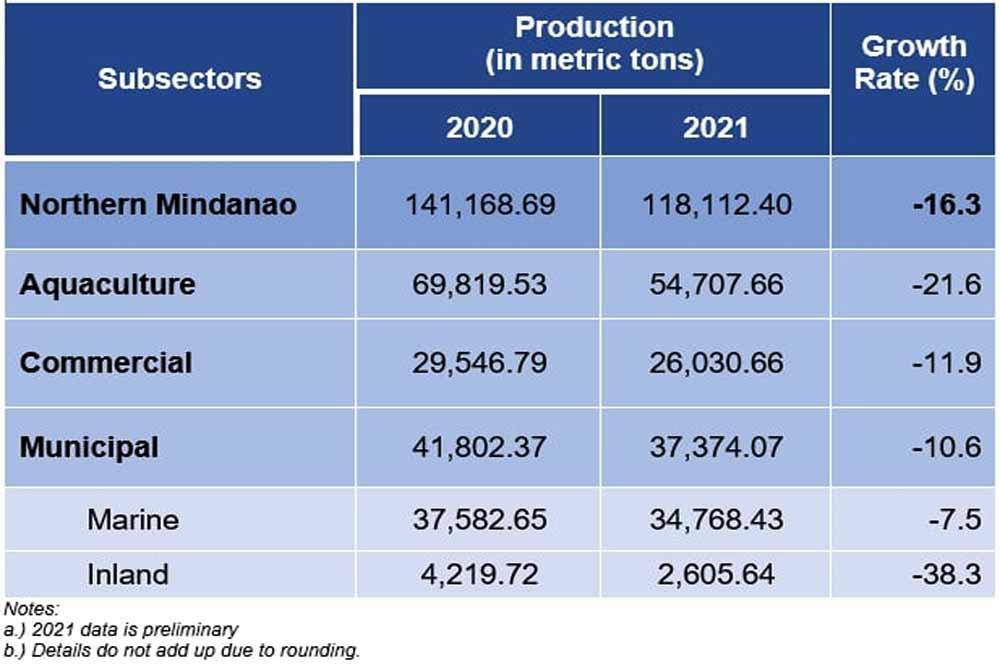
Annual fish production of Northern Mindanao 2020 and 2021. Source: PSA
MindanaoToday.com | Fishery sector hails Panguil Bay Bridge
By: Uriel Quilinguing
CAGAYAN DE ORO CITY – Once travel time is cut by over two hours, one could save on transport cost, and when it comes to fish deliveries, buyers could expect these to be fresh, perhaps even cheaper.
These, after the P3.352-billion 3.77-kilometer Panguil Bay Bridge is formally opened on Friday, September 27, with President Ferdinand Marcos Jr. leading the inaugural rites. It links Tubod, Lanao del Norte and Tangub City, Misamis Occidental.
No doubt, the structure which can be traversed in 10 minutes is vital, instead of queueing for hours to cross the bay by barge, from Mukas Port in Kauswagan, Lanao del Norte to Ozamiz Port of Misamis Occidental. The fastest could be two hours and a half.
Among those who expressed positive outlook on the Panguil Bay Bridge opening was Ibrahim Sanggoyod, an official from the Bureau of Fisheries and Aquatic Resources in Northern Mindanao (BFAR-10). This, he said, is the general sentiment of the stakeholders of the fishing industry here and nearby Zamboanga Peninsula.
Sanggoyod said fish sufficiency of Northern Mindanao is only about 60 percent, hence the region sources the remaining 40 percent of fish demand from Zamboanga Peninsula (Region 9) and Soccsksargen (South Cotabato, Cotabato del Norte, Sultan Kudarat, Sarangani, and General Santos) or Region 12.
Misamis Occidental province which forms part of Northern Mindanao region is situated on the border of Zamboanga del Norte and Zamboanga del Sur, both coastal provinces.
In a Kapihan sa PIA forum in this city on Wednesday, September 18, Sanggoyod said: “Aside from Panguil Bay Bridge’s cutting the travel time of fish carrier (trucks) from Zamboanga to this city, the delivery of inputs and services to municipal fishing and aquaculture areas in would be faster and easier.”
The BFAR-10 official heads the regional project implementation unit of the Modern and Resilient Livelihood Investment (MaRLIn) component of the World Bank-funded Philippine Fisheries Coastal Resiliency (FishCoRe) Project in Fisheries Management Area 9 (FMA 9), where BFAR-10 is the lead region.
He said that the freshness of fishery products, upon reaching the fish-landing area at Westbound Terminal in Bulua, this city, may be observed and, hopefully prices would even be cheaper because of lesser transport costs.
Cagayan de Oro, the regional drop-off point, has been sourcing fish and other fishery products from Zamboanga Peninsula, the annual fishery production of which is over half a million metric tons (mt), compared to Region 10’s 118,112 mt in 2021, according to the Philippine Statistics Authority (PSA).
Northern Mindanao’s fish production that year was negative 16.3 percent of 2020’s 141,168 mt, the PSA recorded.
PSA data shows that in 2021, the annual fish productions of Zamboanga City was 274,851 mt and Zamboanga Sibugay was 128,023 mt, both harvesting more than what the entire Northern Mindanao.
In Region 10, the annual fish productions that year, by province, were: Lanao del Norte 61.316 mt, Misamis Occidental 40,333 mt, Misamis Oriental 12,080 mt, Camiguin 3,777 mt, and Bukidnon 604 mt. Bukidnon is a landlocked province, producing primarily from fishponds. (Uriel Quilinguing/MT)
###